Discover how the Four Keys project simplifies the measurement of DevOps performance by integrating consistent metrics from Git repositories to Google DataStudio. Learn more about DORA metrics.

CEO
Diogo Goebel
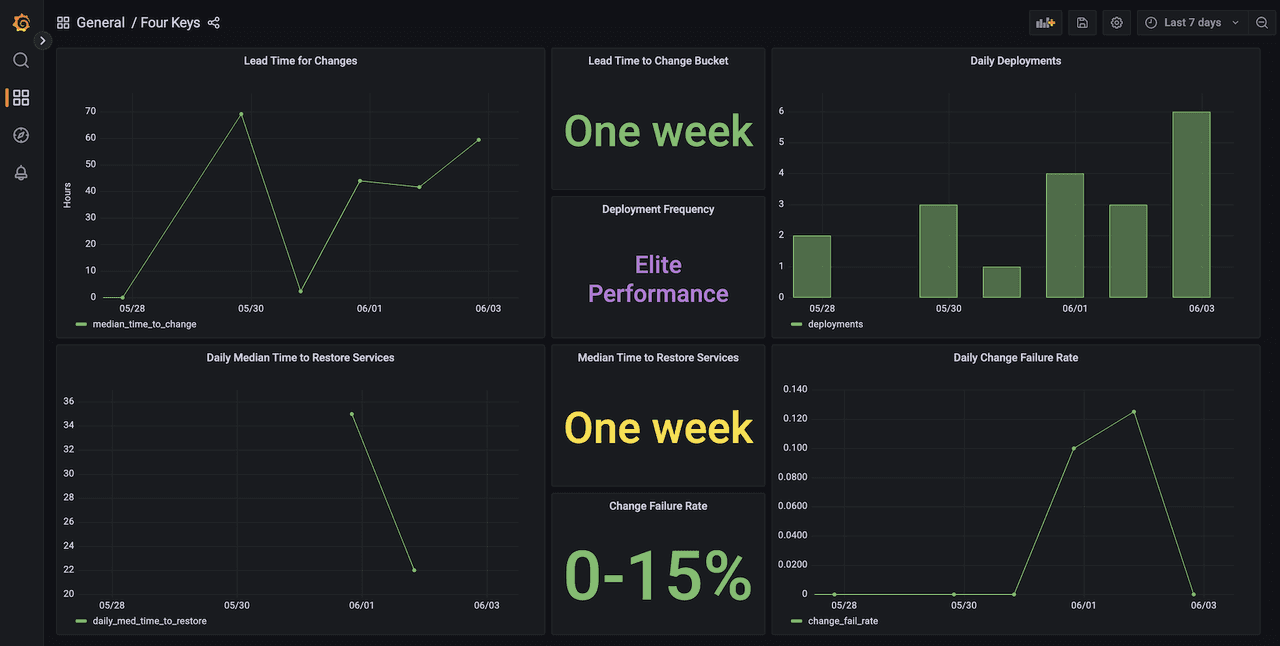
Recently I came across the Four Keys project and found its application extremely relevant, so here is the thread.
If you don't know what "DORA metrics" are, I left a reading at the end
Anyone who has tried to measure their company's DevOps performance knows how complex it can be to get a clear and consistent view of where you are and your progress. DevOps practices exist scattered across different places and tools, and this makes data collection a more than complex task.
In our experience working with clients to improve their SDO (Software Development and Operations), we see that it is relatively simple to find out some metrics from a project leader, for example the lead time of the main project they are involved in.
Finding out the average value of other teams or the whole company is precisely where the challenge lies. Not having consistent metrics ends up creating subjectivity in the way of evaluating and not giving an accurate view of where you are.
That's where the open source Four Keys project comes in as a solution to simplify this process.
Four Keys is an ETL (Extract, Transform, Load) data ingestion pipeline from your GitHub or GitLab repositories. It uses Google Cloud services and integrates everything into Google DataStudio. This simplifies the process, providing a clearer view of performance.
Here is an article with more details and examples, and the project repository.
About DORA
DORA refers to the metrics developed by DevOps Research and Assessment (DORA), a research program dedicated to the study and advancement of DevOps practices. These metrics are fundamental to evaluating and improving software delivery performance through key indicators, which are:
Deployment frequency
Lead time for changes (time for code to reach production)
Change failure rate
Time to restore service (MTTR)
Newsletter Getup.
Atualizações sobre Kubernetes e Software Supply Chain Security todos os meses.
Operating Kubernetes in production for more than 13 years. With Quor, this experience extends to software supply chain security as well.
GET UP
© Getup · 2026